
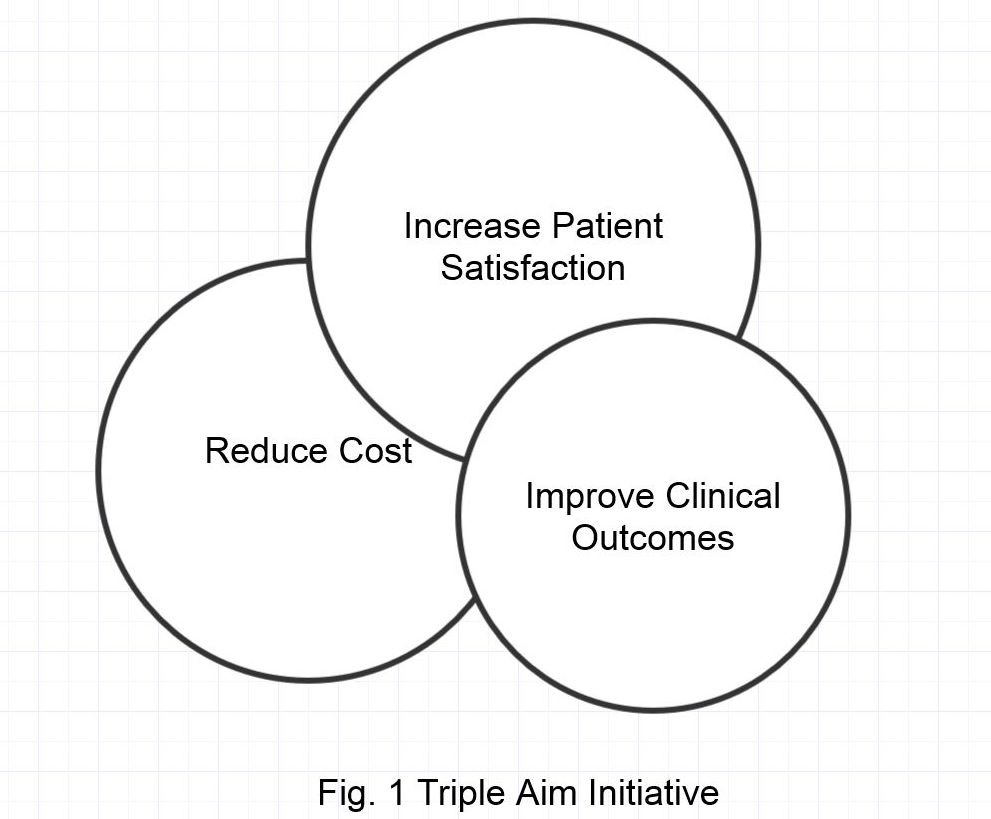
Since the introduction of the Affordable Care Act in 2010, there has been a concerted effort by the health- care industry to improve the “patient experience”. The Institute for Healthcare Improvement developed the Triple Aim Initiative, which focuses on the patient experience of care, improving the health of populations and reducing the cost of healthcare. (Fig. 1) One strategy to improve the patient experience and overall satisfaction is to empower patients to focus and improve upon their own wellness.
 DePuy Synthes Companies and the Johnson & Johnson Human Performance Institute ®, part of the same family of companies, brought their expertise in orthopedic surgery and human energy management together to develop a new educational program for patients undergoing joint replacement surgery. The program focuses on self-guided wellness. The strengths of the Johnson & Johnson Human Performance Institute lie in their research in the study of elite athletes and performance enhancement. After hearing from many joint replacement patients over the years and understanding the surgical journey, DePuy Synthes Joint Reconstruction* recognized the value of bringing a similar program to patients. The goal: improve their overall wellness and help increase patient satisfaction with surgery. For many patients, pain reduction is only one of the goals of joint replacement; an improvement in quality of life is equally important. People who live with joint pain know there is no “off-season” to their pain, and it impacts them each day keeping them from living their lives to the fullest. So, DePuy Synthes Companies undertook a nationwide survey titled “It’s More than Joint Pain” conducted by Harris Poll. The survey found that adults living with osteoarthritis (OA) were less likely to rate their ability to manage stress and sleeping habits as excellent or good compared to adults with OA who had hip and/or knee joint replacement. A program that can deliver enhancements to a patient’s quality of life should in turn improve the overall patient experience. But, this seems to be an area that has been somewhat overlooked in the research literature.
Otani, et al, conducted an analysis to examine how health care managers could develop a strategic plan to improve their patients’ satisfaction levels. In their literature review, they cite “Even though some argue that patient satisfaction is influenced by a bedside manner and patients cannot evaluate the true quality of care, patient satisfaction studies receive more and more attention for several reasons. First, satisfied patients bring business. They are now more empowered, and express their preference over health care providers. They not only seek quality medical outcomes but also quality services”. Interestingly, this empowerment is in the decision-making process toward the doctor, hospital, and other healthcare provider, and does not address patients’ responsibility and ownership of their own self-care, in the pre-habilitation and post-surgical process.
What if the patients were offered an opportunity to have more responsibility in their joint replacement journey? Otani, et al, noted that with the current competitive health care environment, it is important that hospitals develop a strategy that can provide market advantage or differentiation. This raises the question: Is it possible that, if patients are empowered to improve their pre-surgical and post-surgical outlook and habits, overall patient satisfaction could improve? With that as preface, the PATIENT ATHLETE™ Program was developed to add patient responsibility and ownership of their wellness so as to improve overall patient satisfaction.
The PATIENT ATHLETE Program evolved out of the established Corporate Athlete ® Program at the Johnson & Johnson Human Performance Institute, which has trained elite performers on how to manage and expand their energy capacity and thrive under pressure for over 30 years. This patient education version of the program utilizes the same science-based methods, but is customized to a patient preparing for and recovering from joint replacement surgery.
To provide context, the specific application of the Johnson & Johnson Human Performance Institute’s energy management principles to joint replacement patients came about when the first author, a co-founder of the Johnson & Johnson Human Performance Institute, underwent bilateral knee replacement surgery. In his pre-habilitation process and post-surgery rehabilitation, he employed the Johnson & Johnson Human Performance Institute’s energy management technology to his own situation, which led to the genesis of the PATIENT ATHLETE Program and subsequent market research. The second author was one of the surgeons who, along with his medical team, applied the PATIENT ATHLETE Program to an initial cohort of joint replacement patients.
The PATIENT ATHLETE Program is a self-guided, video-based training program designed to help patients preparing for surgery take their experience beyond merely reducing the pain. The program encourages patients to align their personal purpose and with their daily behaviors to emerge stronger, healthier and ready for the next chapter of life. In the weeks leading up to surgery, patients view eight 15-minute lessons, each focusing on one key energy management principle (Fig. 2). Lessons end with assignments designed specifically with the patient’s needs in mind, giving them simple action steps they can immediately use as they prepare for their surgery, and recover after.
 To determine if an energy management program would be beneficial to joint replacement patients, DePuy Synthes Companies conducted a pilot of this program with three orthopedic surgeons at three different hospitals.
Each surgeon enrolled 20 patients in the program and provided the workbook and DVDs prior to surgery. Of the total 60 patients given the program, 33 patients completed a patient satisfaction survey at a minimum of 90 days after surgery.
Survey results show:
· 52% were less fearful of surgery because of this program
· 70% were more confident of surgery because of this program
· 55% felt they recovered more quickly than expected because of the program
· 68% felt they are more fully engaged with the people and things that matter most to them because of this program
· 88% would recommend the program to family and friends
Patients answered a short 15 question survey on their perception of the program and its value to them as a patient.The survey results confirm that patients perceived benefits from participating in the PATIENT ATHLETE Program, and these results may have a direct impact on not only the overall patient experience with joint replacement surgery, but may also impact general overall health and health related quality of life. Furthermore, the ability to motivate and energize patients to take ownership in, and to improve their own wellness before surgery, may help decrease the ever increasing cost burden on the US healthcare system.
Today, Centers for Medicare & Medicaid Services is actively measuring patient satisfaction via HCAHPS surveys as are many other payers and providers through various market research formats. With this trend, it is critically important for healthcare providers to offer and support programs that aim to improve the overall wellness of their patients and to help them have a better experience within a given healthcare episode.

Jack Groppel is the Vice President of Applied Science & Performance Training, Wellness & Prevention, Inc., a Johnson & Johnson company, and Co-Founder of the Human Performance Institute®. He is an internationally recognized authority and pioneer in the science of human performance, and an expert in fitness and nutrition.